

On November 17, a 25-year-old barber from Buea set out to break the Guinness World Record for the longest professional hairdressing marathon. The record to beat was 72 hours, set by a Nigerian barber in January. Ola Clovis Abang, AKA Clocutz, gave himself a target: 120 hours.
For months, he prepared himself mentally and physically while a dedicated team worked tirelessly to organize the event and galvanize community support. People in his entourage have talked about the number of times Clovis felt like he had bitten off more than he could chew, how doubt and despair crept in when it seemed like there wasn’t enough support coming his way.
With or without public support, Clovis had no choice. An earlier application to Guinness had been rejected, so this was not something he could just postpone to when he felt more ready, or to when the support would come. On November 17, he mounted the stage at Molyko Stadium and started cutting.
The first few hours looked like the lonely early days of every entrepreneur. There was little fanfare. The photos on his social media page all pointed at the stage. As an event organizer, I know all too well what that means. When the crowd is thin, you point the camera at the stage.
Then the lights went out. Almost 24 hours in, a power outage hit, the rented generator failed, and Clovis had to restart the marathon from zero
That is when Cameroon showed up. Within hours his event became the most important thing happening in the country. For the days that followed, artists cancelled releases, and everyone who had something else to say or sell online was forced to change plans. The algorithm was marching to the buzz and vibrations of Clovis’s clippers.
Now the rhetoric online is about how much Cameroonians support their own. An outside observer would believe that. But I can tell you there have been many more noble causes where such support was needed and none came. This is no attempt to undermine what Clovis did. He earned every cheer. I only want us to be honest about what we were cheering.
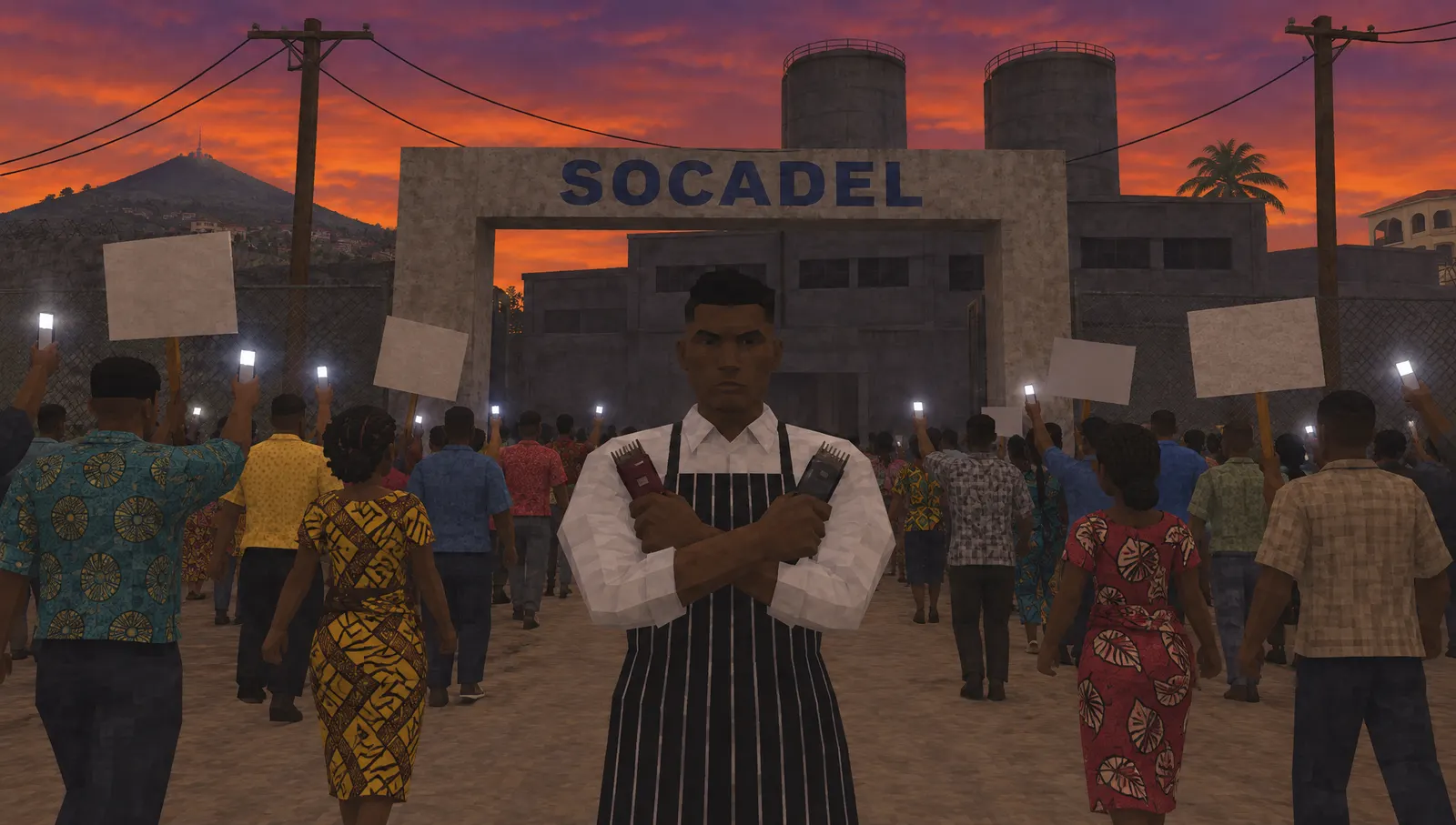
Look at when the support came. It did not come when he announced the attempt. It did not come when he mounted the stage. It came after the blackout. A power outage and a dead generator suddenly made the average Cameroonian see themselves in Clocutz. People came out for Clovis, yes. But they stayed because of SOCADEL, MTN, and Orange. What we saw in Buea was a celebration, and it was also a protest that did not know it was one.
How many of us have lost opportunities because of no electricity and poor internet? I know I have. I know a mother, Renette, who had to throw away months of breast milk she had been saving for her children because of a prolonged power outage. Almost everyone reading this, rich or poor, can tell you a story in which ENEO cost them something. ENEO is now SOCADEL. The name changed in May. The darkness did not.
And electricity was only half of it. Anywhere else, the simplest proof of a five-day record would be a five-day livestream: one unbroken feed, timestamped, with the whole world as witness. In Cameroon that is a fantasy. Less than three weeks before Clovis mounted the stage, subscribers were boycotting MTN and Orange over data that disappears and networks that drop. A week before, the regulator gave MTN, Orange, and Camtel fifteen days to fix failures it valued at 18.6 billion francs. That deadline was still running when Clovis put down his clippers. So his team did what every Cameroonian does. They worked around it, and hoped the workaround would hold.
I have previously written that Cameroon, its citizens and government alike, operates on moments, not systems. A viral video of vehicles skidding down a muddy road is what unlocks road maintenance funds, not a road inspection committee. Here is the uncomfortable part: Buea was a moment too. We protested the absence of systems in the only way we know how.
I once had a conversation with the former UN Resident Coordinator in Cameroon, and he talked about how resilient Cameroonians are, how analysts have predicted many times that Cameroon will implode, yet the country keeps its head above water, always looking like it is about to collapse but never going down. Like one Cameroonian street philosopher put it, “dans le film des pays, le Cameroun c’est le chef bandit”. We say it with pride. We should not. Resilience is the tax we pay for systems that do not work, and every time we are praised for it, the failure becomes a little more normal.
Clovis is just one of millions of Cameroonian youths who are hardworking, industrious, strategic, and intelligent, but who, without a public moment of sympathy, suffer in silence as they watch age deplete their energy and steal their dreams and ambitions.
We have come to the point where individuals are trying to substitute for systems. Today waste management in Buea has become the business of a comedian, Spaco Lee, and in Yaoundé it is the job of Achille Tanko. I salute them. But that is not sustainable.
Clovis put down his clippers at 96 hours, 24 hours past the record, and now waits for Guinness to certify it. The power cut had already taken almost a day of work that will never be counted. That is the detail I cannot get past, because it is the one every Cameroonian knows from the inside: the hours we put in that the system erased.
So let us celebrate him. But notice what else happened that week. While the country counted his hours, the deadline to stand for our councils and our parliament came and went on November 24. On February 7 we will choose the people responsible for the refuse a comedian is clearing in Buea, and the people meant to hold SOCADEL to account. Most of the young people who filled Molyko could not name one of them.
I understand why. We have voted before, and the lights still went out. But a moment asks nothing of those in power. They can wait for a moment to pass.
No citizen can build a power grid. But citizens can build the thing that forces a government to build one: associations that follow the council budget, voters who demand commitments in writing, neighbours who show up after the cameras leave. Clovis did not get to 96 hours on a moment. He got there on months of preparation and a team.
The crowd in Molyko has gone home. The algorithm will find another moment. And somewhere tonight, a young person just as gifted as Clovis is sitting in the dark, with no stadium and no hashtag.
A country cannot run on moments.