Home · Topic

Elections

Politics & Government

24

Essays · 2017–2025

essay · 1 min

The Arithmetic of Fragmentation: Cameroon's Party System and the Limits of Electoral Choice

With over 180 registered political parties competing for 280 parliamentary seats, Cameroon's electoral landscape has become a study in mathematical impossibility and institutional dysfunction. The post documents how administrative barriers, factional splits, and an oversized party roster have turned recent elections into a cautionary tale about the gap between formal democratic structures and meaningful political participation.

Norbert Foy · 29 July 2025

Opinion · 5 min

The Eto'o Presidency and the Temptation of the Strongman

Following Samuel Eto'o's election as FECAFOOT president in 2019, Cameroonians rallied around him as proof that fair elections and competent leadership were possible. But within eighteen months, allegations of misconduct emerged, and the writer observes that public support for Eto'o—despite the accusations—reveals a deeper problem: the nation's willingness to tolerate autocratic governance and personality cults so long as results appear.

Wandji Wilfred · 28 February 2019

Opinion · 4 min

Post-Elections: On Respect and the Cost of Public Sacrifice

Following the 2018 presidential election, the writer defends Cabral Libii against social-media derision over his appearance and lifestyle, arguing that Cameroonians are undermining their own political actors through petty criticism rather than substantive debate. The piece calls for a culture shift: toward recognizing the sacrifices of those who mobilize youth politically, and away from corrosive cynicism that discourages future leaders.

Norbert Foy · 13 November 2018

essay · 4 min

Is Stanley Enow Fit for President of Cameroon?

This piece examines the prospect of Stanley Enow, a prominent Cameroonian musician, running for president—a question prompted by global celebrity-to-politics movements and local precedent. The writer weighs his artistic reputation, communication skills, and bilingualism against his political silence, selective collaborations, and apparent distance from Cameroon's pressing crises.

Mata Harri · 27 October 2018

essay · 5 min

The Social Democratic Front at a Crossroads: Reckoning with Electoral Defeat and Democratic Legacy

Following a disappointing electoral performance in 2018, the writer reflects on the SDF's historical contribution to Cameroon's democratic gains and analyzes the specific failures—the Anglophone crisis, internal divisions, refusal to form coalitions, and disconnect from younger voters—that led to its decline. The piece proposes three concrete steps for the party's recovery: backing Maurice Kamto, restructuring its base to engage younger supporters, and maintaining continuous grassroots engagement beyond election cycles.

Wandji Wilfred · 17 October 2018

Opinion · 6 min

Slay Queens and Politics: The Unholy Matrimony

The writer examines the tension between social media prominence and political accountability through the case of a Cameroonian influencer whose eyebrow shop opening was attended by a state minister, and who later appeared in CPDM campaign materials. The piece interrogates what it means for those with access to power to remain silent about state violence and injustice.

Wandji Wilfred · 12 October 2018

essay · 4 min

Why Design Matters for the Future of Cameroon

Design is not a luxury but a psychological and civic necessity: the aesthetic quality of our built environment shapes who we become. Drawing on the 2018 presidential race and broader historical examples, the writer argues that Cameroon's future depends on treating design—from campaign materials to urban planning—as a serious act of nation-building.

Norbert Foy · 11 October 2018

essay · 5 min

Etoudi 2018: Winners and Losers in Cameroon's Presidential Election

An analysis of the 2018 Cameroonian presidential election identifies Maurice Kamto and Akere Muna as victors for forming and joining an opposition coalition, while the Anglophone population, candidate Cabral Libii, and the SDF party emerge as significant losers. The piece examines how political strategy, timing, and the failure to leverage collective movements shaped the election's outcome.

Wandji Wilfred · 10 October 2018

essay · 3 min

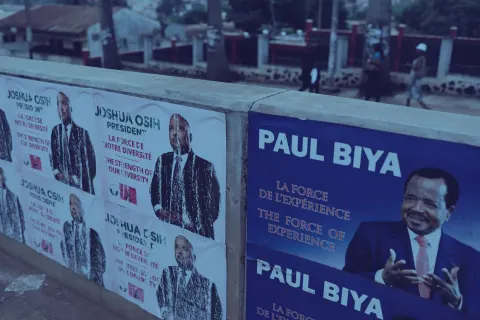
The Force of Experience vs. the Winds of Change: Reading the 2018 Election

The writer argues that President Biya's campaign strategy in the run-up to Cameroon's October 2018 election was carefully calibrated to exploit regional divisions and voter suppression rather than to ignore the anglophone crisis. Through regional voter analysis and observed patterns of displacement and military presence, the piece suggests that apparent momentum for opposition candidate Kamto may obscure a closer actual result.

Norbert Foy · 8 October 2018

Opinion · 1 min

The Final Hours: Opposition Consolidation and the Cost of Disunity

As the 2018 Cameroonian presidential election neared, the writer examines the last-minute strategic calculations facing candidates Osih and Cabral following Akere Muna's withdrawal and endorsement of Maurice Kamto. The piece argues that both candidates face a binary choice: unite behind Kamto or risk permanent political and moral damage.

Staff · 6 October 2018

essay · 6 min

Joshua Osih's Governance Programme: A Close Reading

This piece offers a detailed examination of Joshua Osih's 84-page presidential platform, focusing on his substantive proposals across governance, health, education, economic policy, and social reform. The writer presents the programme as notably comprehensive and structured compared to other candidates' offerings, though acknowledges its density and point-form presentation.

Wandji Wilfred · 5 October 2018

Showing 1–12 of 24